AI for process reliability in chemical manufacturing and beyond
Detect deviations early. Understand what is causing them. Act before faults disrupt production.
A fault in one part of a plant can affect pressure, flow and temperature elsewhere. By the time an alarm sounds, its effects may have spread well beyond the source.
Plants collect large amounts of process data, but monitoring systems often leave engineers to work out how those changes are connected.
Tracing the cause manually can take days or weeks, delaying corrective action.
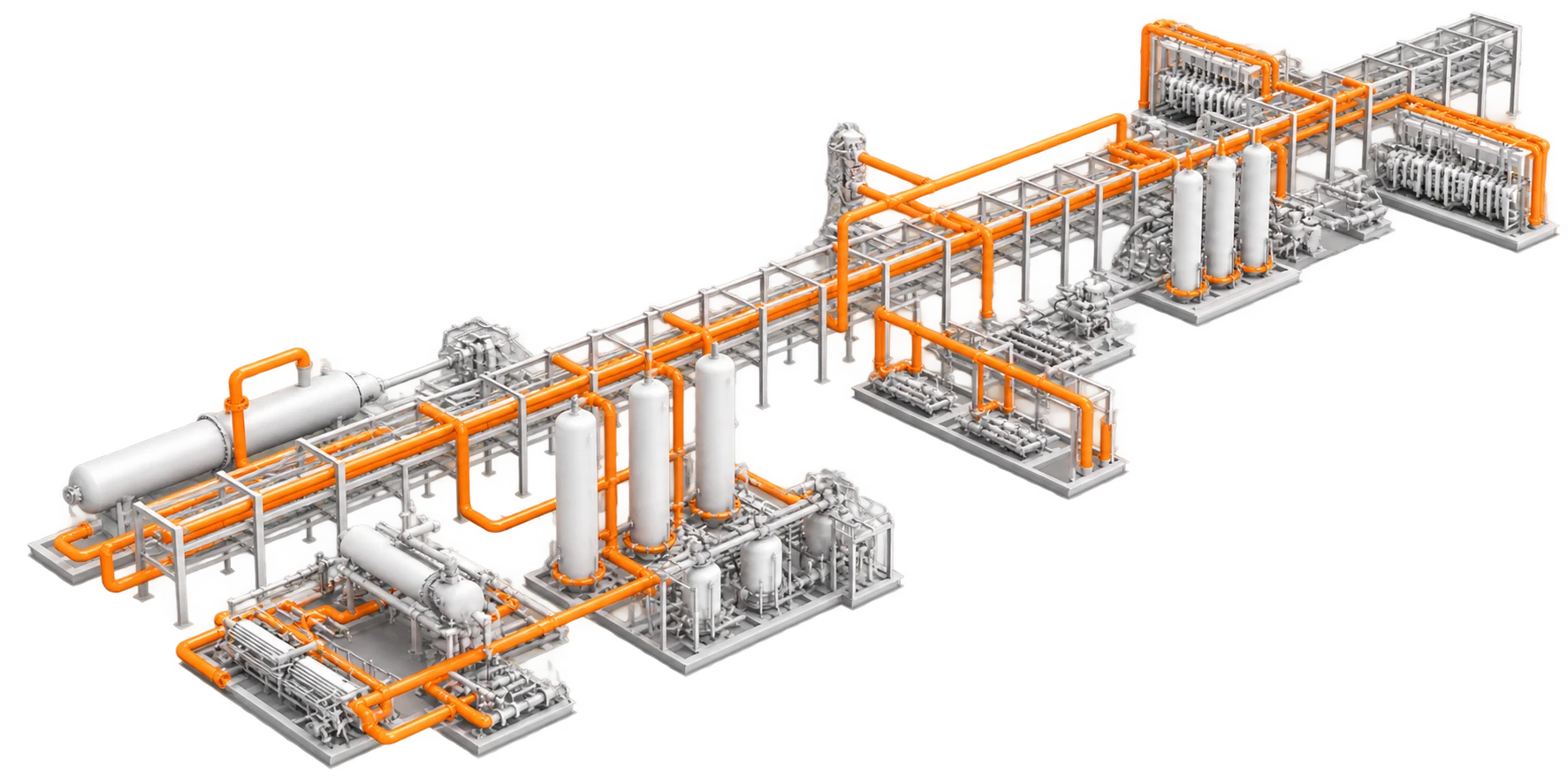
Fouling, crystallization or a partial blockage develops in one part of the process.
Pressure, flow and temperature begin to deviate. Controllers compensate, and alarms multiply across the system.
A pump vibration alarm, for example, flags a symptom. Engineers still need to trace its cause while deciding how to keep production running.
Overall Equipment Effectiveness (OEE) combines availability, performance and quality to measure how much of a plant's planned production capacity becomes good product. Move the sliders to see how losses in each factor affect the overall result.
76% × 60% × 90%
A 5-point OEE increase means 12% more good output at the same planned production time and design rate.
KIIO models the relationships between process variables and control actions. Changes in these relationships can reveal faults before individual signals trigger alarms, helping your team detect problems earlier, reduce false alarms and investigate the cause.
Track how process variables and control actions relate to each other as operating conditions change.
Identify whether a fault likely starts in a sensor, an actuator or the process itself, and trace how its effects spread.
Estimate how severe a fault is and how confident the diagnosis is, helping your team decide what to investigate first.
Give process and maintenance teams likely explanations and specific checks to verify them.
KIIO estimates fault severity, distinguishes sensor and actuator problems, and reconstructs missing data using relationships between variables.
KIIO estimates fault severity and the uncertainty in its diagnosis. It also tracks gradual degradation, helping your team judge how quickly a problem is developing and plan when to intervene.

An unexpected reading can come from a drifting sensor or an actuator that no longer responds to commands. KIIO models how control actions affect the process to help distinguish the two and identify which component to check.

Data gaps, noise and irregular sampling are common in plant datasets. KIIO uses relationships between variables to reconstruct missing or corrupted values. It also learns the delays caused by material moving through the plant and controllers responding, without manual time alignment.

Industrial AI, graph neural networks for complex systems, and predictive maintenance.

15+ years at Nestlé, Michelin and Walgreens. Experience in enterprise B2B; second-time founder.

Experienced chemist and entrepreneur in sustainable chemical manufacturing.

Industrial executive with 20+ years' experience in operations and business development.

Expert in graph-based machine learning and intelligent systems. Scientific director at IDSIA.
Tell us about your process and the faults you want to investigate. With historical data and documented incidents, we can assess the case together and plan an offline proof-of-value study.